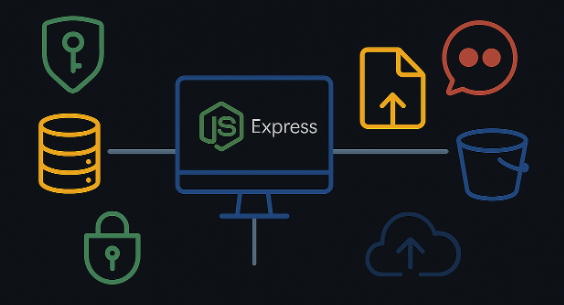
Back-end Microservices with Node.js and Express: Building Scalable Server Logic for High Concurrency

Microservices have changed how modern back-end systems are designed. Instead of shipping one large application, teams split the back end into smaller services that can be built, deployed, and scaled independently. Node.js and Express are widely used for this style of architecture because they support lightweight services and handle high numbers of concurrent requests efficiently. The key is understanding how Node.js manages asynchronous work through its event loop, and how Express can be structured to keep services fast, maintainable, and production-ready. Many developers exploring a full stack developer course in pune aim to build exactly these skills because microservice-based systems are common in real-world applications.
Why Node.js Fits Microservices
Node.js is designed around non-blocking I/O. That means operations like reading from a database, calling another service, or fetching data from a queue do not freeze the server while they complete. Instead, Node.js starts the operation, registers a callback or promise, and continues handling other requests. This model is especially effective for microservices, which often spend time waiting on external systems rather than doing heavy computation.
Microservices also benefit from Node.js because services are typically small and focused. Startup time is quick, memory footprints can be modest, and development cycles are fast. When paired with container orchestration platforms, these small services can scale horizontally as traffic increases. However, to get real performance gains, developers must write code that avoids blocking the event loop and uses concurrency patterns correctly.
Express as a Lightweight Service Layer
Express is a minimal web framework that provides routing, middleware, and request handling without forcing a complex structure. For microservices, this simplicity is an advantage. Each service can expose a small set of endpoints and focus on one business capability, such as authentication, payments, or notifications.
A strong Express service design usually includes:
Clear routing boundaries
Routes should map cleanly to a service responsibility. For example, a billing service should not contain user profile routes. This makes ownership and scaling decisions easier.
Middleware used with discipline
Middleware is powerful for tasks like validation, authentication, rate limiting, and logging. The key is keeping middleware small, predictable, and ordered properly so performance and debugging remain manageable.
Consistent error handling
Microservices must return reliable error responses. Centralised error handling middleware helps standardise status codes, error formats, and logging. This consistency matters when services interact with each other and when monitoring tools are used.
By following these patterns, Express stays lightweight while still supporting production-grade needs.
See also: The Science Behind Mental Health First Aid Techniques
Mastering the Asynchronous Event Loop for High Concurrency
High concurrency is not only about handling many requests. It is about ensuring the server remains responsive under load. Node.js uses a single-threaded event loop for JavaScript execution, backed by a thread pool for certain tasks. If your code blocks the event loop, concurrency collapses. This is why asynchronous design is essential.
Use async and await correctly
Async functions make code readable, but they do not automatically make it non-blocking. If an awaited call triggers a slow synchronous operation, the event loop still suffers. Always ensure that heavy work is offloaded to external systems or background workers.
Avoid CPU-heavy tasks in request handlers
Tasks like large JSON transformations, file compression, encryption at scale, or complex calculations can block the event loop. For such workloads, use worker threads, separate services, or queues. Microservices should stay I/O-focused where Node.js is strongest.
Handle timeouts and retries carefully
Microservices frequently call other services. Without timeouts, requests can pile up and exhaust resources. Use short timeouts, circuit breakers, and retries with backoff to keep systems stable during partial failures.
Control concurrency for downstream dependencies
Even if Node.js can accept many requests, your database or third-party APIs may not. Use connection pooling, queueing, and rate limiting to prevent overload. A well-behaved microservice protects its dependencies.
These practices are core to building scalable systems and are often emphasised because they directly affect production reliability.
Operational Essentials for Production Microservices
Microservices succeed when they are observable and manageable. Production readiness requires more than correct code.
Logging and tracing
Structured logs with request IDs help correlate events across services. Distributed tracing adds visibility into latency across service boundaries.
Health checks and graceful shutdown
Services should provide readiness and liveness endpoints so orchestrators can manage deployments. Graceful shutdown ensures in-flight requests finish cleanly during restarts.
Configuration and secrets management
Avoid hardcoding environment details. Use environment variables or configuration services, and manage secrets through secure vaults.
API versioning and contract discipline
Microservices evolve independently, so changes must be backwards compatible whenever possible. Version APIs when needed and document behaviour clearly.
These practices reduce incidents and make scaling predictable.
Conclusion
Back-end microservices with Node.js and Express are a practical choice for teams that need fast, scalable, and maintainable server-side systems. Node.js delivers strong concurrency through non-blocking I/O and an efficient event loop, while Express provides a simple framework for building focused services. The real difference comes from disciplined asynchronous design, careful dependency management, and operational best practices such as observability and graceful shutdown. Developers aiming to work on modern distributed systems often build these competencies through hands-on learning paths like a full stack developer course in pune, where microservice patterns and high-concurrency fundamentals are directly aligned with industry needs.